MR SAVETHEBRAIN
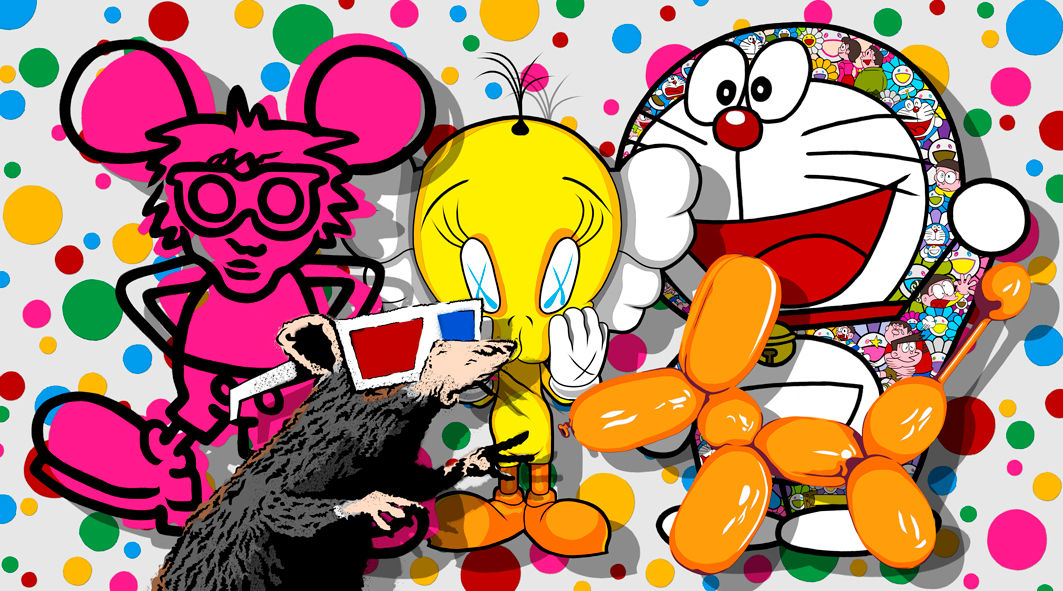
FRIENDS
Museum-Grade Post-Digital Fine Art Painting
100 × 180 cm | 39 × 71 in
COLLECTOR INFORMATION
Off-Market · Direct-to-Collector · Venice, Italy
ORIGINAL EDITION AVAILABLE
Private Inquiry
Request edition availability, official price and acquisition terms.
No obligation to purchase.
THE SCRIPT
WRITTEN & DIRECTED BY MR SAVETHEBRAIN
In FRIENDS, MR SAVETHEBRAIN conceives and directs an impossible celebration in which two worlds deeply embedded in our collective visual memory — American television culture and contemporary art — meet within a surreal Visual Performance. The familiar universe of one of the world's most recognizable television series becomes the setting for a party that never took place.
Chandler, Phoebe, Rachel, Ross, Monica and Joey become the Actors of this impossible celebration. Rather than returning them to a familiar television episode, MR SAVETHEBRAIN places their relationships on an unfamiliar stage, where humor, affection and seemingly ordinary gestures acquire meanings the audience has never been asked to consider.
At first, the scene appears joyful, playful and reassuring. Through the seductive use of color, irony and the wonder of a world seen through the eyes of a child, the Artist constructs a celebration in which individuality, affection and belonging seem to coexist without contradiction.
Yet beneath this apparent innocence lies a deliberate provocation. The Artist transforms a familiar world into a stage where society's expectations of identity, masculinity and normality are challenged, exposing the relationship between individual freedom, social perception and the cultural construction of prejudice.
The controversy, irreverence and irony that distinguish MR SAVETHEBRAIN's artistic practice emerge through this contradiction.
THE CONTROVERSY DOES NOT ARISE FROM THE EXTRAORDINARY APPEARANCE OF THE ACTORS, BUT FROM THE ORDINARY HUMAN FREEDOM THAT THE REAL WORLD CAN STILL STRUGGLE TO ACCEPT.
THE ACTORS — IMPOSSIBLE VISUAL CONVERSATIONS
The transformation of the protagonists into animal figures constitutes one of the central conceptual devices of FRIENDS.
Within the symbolic universe of the Masterpiece, animals embody a fundamental form of acceptance, in contrast to the social hierarchies, stereotypes and prejudices through which human beings interpret difference.
MR SAVETHEBRAIN introduces a symbolic reversal of the relationship between humans and animals, questioning our presumed cultural and social superiority.
How is it that we can recognize ourselves in characters that do not resemble human beings, yet sometimes struggle to recognize ourselves in other human beings?
Within this surreal universe, each Actor assumes a distinct visual, psychological and conceptual role.
Chandler Bing, reimagined through Doraemon and the visual language of Takashi Murakami, embodies the relationship between humor and vulnerability. The contrast between his reassuring expression and his underlying fragility recalls the sarcasm through which Chandler, in the television series, navigates his insecurities and his desire to be loved.
“I'm hopeless, and awkward, and desperate for love!”
The familiar line acquires a new psychological dimension. Humor becomes a protective mechanism, a language through which vulnerability can be expressed without being fully exposed. The smile is not false. It simply does not tell the whole story.
How many times have we smiled to keep the people we love from worrying about us?
Phoebe Buffay, represented through Banksy's Rat, introduces a reflection on the limitations of perception. The fake 3D glasses she wears create a visual paradox: they promise greater depth of vision without being able to provide it.
MR SAVETHEBRAIN uses this detail to challenge the certainty with which we interpret reality. The conviction that we see clearly can become a form of blindness when our perception of others is shaped by preconceived stereotypes and prejudices.
What if we were the ones being looked at through those very same glasses?
Her famous lobster metaphor, “He's her lobster,” also acquires a new resonance. Through the animal world, Phoebe had already found a language to express the complexity of human relationships. Closeness and love do not require sameness.
Rachel Green, reimagined through Mr. Brainwash's Orange Balloon Dog, explores the relationship between identity, visibility and recognition. Her luminous, affectionate presence asserts itself within the composition without monopolizing attention.
Through Rachel, the Artist proposes a form of individual visibility founded not on competition, but on the freedom to exist fully alongside others. To be visible without making someone else invisible.
Ross Geller, represented through Keith Haring's Mickey Mouse, conceals a gift behind his back. The gift, still hidden from the others, introduces a reflection on the value of a gesture independent of its recognition.
In a society where even generosity can become a form of self-presentation, Ross embodies the quiet dimension of affection. An act of love retains its value even when no one sees it.
What unseen acts of love have changed our lives?
Monica Geller, in dialogue with the visual universe of Yayoi Kusama, assumes a role that extends beyond the representation of an individual character. The repetition of dots, the lights, the balloons and the chromatic rhythm of the composition visually express her role in organizing the celebration and nurturing relationships.
These seemingly decorative elements become part of an emotional architecture through which MR SAVETHEBRAIN portrays care, hospitality and the creation of a shared space. Monica does not simply participate in the party: she helps create the conditions that make it possible.
Together, these five presences establish a network of relationships in which individuality is not an obstacle to belonging. It is within this carefully constructed balance that MR SAVETHEBRAIN introduces, through Joey, the central conceptual tension of the Masterpiece.
JOEY — IDENTITY, FREEDOM AND CONTROVERSY
Joey Tribbiani, reimagined through Tweety in the visual language of KAWS, is the protagonist of FRIENDS and the focal point of its provocation and controversy. Not because of who he is, but because of what society still chooses to regard as controversial.
In collective memory, Joey embodies the self-confident seducer, a near-caricature of masculinity. MR SAVETHEBRAIN uses this established identity to generate a Conceptual Short Circuit between what the public recognizes and what it does not expect to see.
The mascara, makeup and painted nails destabilize the stereotype, while the gloves partially protect his painted nails, introducing a more intimate dimension of freedom: the right to decide when, how and how much of oneself to reveal. It is not Joey's identity that changes, but our perception of it.
The decision to place Joey's coming out at the height of the celebration is deliberate. Joey chooses this moment precisely because he is happy, surrounded by the people he loves. His coming out is not a confession born of shame, but an act of trust.
Who are the people around whom we have never been afraid to be ourselves?
The naturalness with which Joey shares his identity introduces, by contrast, one of the most intimate and painful dimensions of homophobia: the fear of losing the affection of those we love at the very moment we choose to be honest with them.
If a child is afraid to tell their parents whom they love, whose love are they afraid of losing?
Joey does not seek to conform to anyone else's idea of normality. He lives his own, alongside theirs. His strength does not come from the approval of the group: it was already his, regardless of the wounds prejudice may have left.
THE WOUND IS REAL. IT DOES NOT DECIDE WHO YOU BECOME.
In FIND YOUR HAPPY PLACE ↗, the two female protagonists exercise this same freedom by choosing not to expose themselves further to the gaze of others. In FRIENDS, Joey instead chooses to reveal another part of himself.
Through an Impossible Conceptual Conversation between the two Masterpieces, two apparently opposite gestures reveal the same freedom: the freedom to decide how much of ourselves belongs to the world and how much remains ours alone.
After encountering FIND YOUR HAPPY PLACE, the Viewer may return to Joey's smile and discover that the most radical part of the celebration was almost invisible: he never needed his friends' permission to be himself, but he could trust them not to turn his truth into a spectacle. The two women protect that same freedom by refusing a gaze that has become a form of possession. Neither painting changes. What changes is the question we bring back to it: when does being seen become an act of love, and when does it become a violation?
ONE REVEALS. THE OTHERS WITHDRAW. THE FREEDOM IS THE SAME.
His iconic line, “How you doin'?”, also acquires a new meaning. Once directed toward others as an expression of seduction, the question now returns to Joey himself, inviting the Viewer to see the person beyond the stereotype.
Yet the most radical provocation lies in the naturalness with which the other Actors respond. No one interrupts the party. No one turns his coming out into a spectacle. Joey shares another part of himself, his friends stay, and the celebration continues.
Why can the absence of a reaction still constitute an act of radical provocation today?
NOTHING HAPPENED. EXACTLY.
FRIENDS — HAPPINESS AS A FORM OF PROTEST
FRIENDS was conceived as a denunciation of homophobia. Its central provocation is not the act of coming out, but the absence of conditions placed upon belonging.
The party does not stop when Joey reveals a part of himself. His friends do not turn his revelation into an event, a declaration of tolerance or a moment requiring their approval. He remains exactly where he was: among the people he loves, already belonging. MR SAVETHEBRAIN imagines something disarmingly ordinary — the freedom to be oneself without having to fear losing the affection of those we love. In a world where this freedom can still carry consequences, the fact that nothing extraordinary happens becomes the provocation.
That ordinary freedom enters into dialogue with the deeper meaning of Pride, where the right to be oneself and to love becomes a collective assertion of human dignity and equal rights.
How many people must take to the streets so that two can hold hands without fear?
HAPPINESS BECOMES A FORM OF PROTEST.
Within the surreal and conceptual universe of FRIENDS, these freedoms are entirely natural. It is the real world, rather than the surreal composition, that reveals its own absurdity.
Why must those who suffer prejudice find the courage to be themselves, while those who perpetuate it can continue to consider themselves normal?
THE SCANDAL IS NOT DIFFERENCE. THE SCANDAL IS THAT DIFFERENCE CAN STILL COST A HUMAN BEING LOVE, SAFETY OR LIFE.
Through THE SCRIPT, the Viewer is invited to return to the Masterpiece. The characters still occupy the same space. Phoebe wears the same glasses, Ross still conceals his gift, and Joey is still smiling. The party has never been interrupted.
When the Viewer returns to the Masterpiece, the image remains unchanged. The way they see it may have changed.
If this party were not a Masterpiece, but a moment in your own life, could it unfold in the same way?
LOVE IS EVERYTHING.
THE STOP
A SOVEREIGN TOTAL PERFORMANCE.
THE PRIVILEGE OF DISCOVERY
"THE STOP" ↗ is the conceptual and surreal universe through which MR SAVETHEBRAIN challenges the conventions of contemporary art, redefining the relationship between artwork, space, human presence, discovery and collecting.
Every Masterpiece is a physical manifestation of this universe. The first encounter may occur anywhere in the world, even in the intimacy of a private space, in front of a screen.
In Venice, "THE STOP" assumes a spatial dimension. The city becomes the Artist's Sovereign Urban Art Gallery, where Artist's Proofs (AP) serve as instruments of provocation through temporary Sovereign Artistic Incursions within historic palazzos, secluded gardens, luxury hotels, distinguished restaurants and private residences.
Each Sovereign Artistic Incursion is conceived in confidential agreement with its host, respecting the architectural identity and character of the space.
Without public announcements or predetermined exhibition routes, MR SAVETHEBRAIN transforms the unexpected encounter into a performative device. The Masterpiece, architecture and human presence converge in a personal experience where beauty, wonder and controversy coexist.
Beauty becomes the first language of the encounter. Through color, scale and visual presence, the Masterpiece enters into dialogue with the architecture, materials, light and interior design of its surroundings. The work does not merely complement the space. Its presence introduces a new aesthetic and conceptual dimension through which the architecture itself may be experienced differently.
The architecture is not simply a backdrop. It becomes an Actor in an Impossible Spatial Conversation, where the Masterpiece, its surroundings and human presence give rise to THE THIRD SPACE. For a hotel, this encounter becomes part of the guest experience: an unexpected cultural moment capable of remaining in the memory of a journey, without becoming a conventional exhibition or commercial presentation.
These Sovereign Artistic Incursions belong exclusively to Venice. Conceived within the extraordinary intimacy of selected historic palazzi, private architectural spaces and exceptional luxury hospitality environments, they are not public exhibitions or destinations announced to an audience. The few who may encounter a Masterpiece do so within the ordinary life of a place they were already entitled to enter. Their privilege is not exclusive admission to an artwork, but the extraordinary possibility of discovering something that was never announced.
The Viewer encounters the Masterpiece before any explanation is offered. Nothing is imposed upon that first experience. Beauty, curiosity and emotion are free to emerge before interpretation. For those who choose to explore further, THE SCRIPT invites a second encounter with the same Masterpiece. The image remains unchanged. The way it is experienced may have changed.
At first, the Viewer looks at the Masterpiece. Then the encounter may reverse its direction: the Masterpiece seems to look back. Not at the Viewer's face, but into the human questions they carry — love, fear, belonging, insecurity, prejudice, hope and the need to be seen without being judged. This is the Semantic Mirror: the artwork does not know the Viewer or dictate what they should feel. Through beauty, irony and the relationships between its Actors, it may reveal something the Viewer never expected to recognize in themselves. This is where Shared Humanity becomes personal.
Each Masterpiece is autonomous: its beauty, its Actors and its own human questions are enough to make the encounter possible. Yet the Masterpieces are complementary. Two may appear side by side during a Sovereign Artistic Incursion in Venice, or be discovered years apart, on a screen or within a private collection. Their Actors need not share the same canvas to enter an Impossible Conceptual Conversation. A new encounter may lead the Viewer to question something they thought they understood in an earlier one. The Masterpieces remain unchanged. What the Viewer discovers within them may not.
In a society where almost every experience is anticipated and planned, might the privilege of discovery be one of the most authentic forms of luxury?
YOU DO NOT HAVE TO FIND THE STOP. THE STOP FINDS YOU.
BEYOND THE GALLERY SYSTEM
The provocation extends to the art system itself. While the two Artist's Proofs are reserved for the Performance, the eight numbered examples of the Original Edition are neither produced in advance, exhibited for sale, nor distributed through the conventional gallery system.
Their source, the Sovereign Master File, is securely held in a bank vault in Venice. Each numbered example is brought into physical existence by the Artist only following its formal private allocation.
Acquisition takes place exclusively online, directly from the Artist through the Social Silence Office, without intermediaries or the need to travel to Venice.
Can a work of art challenge the very system that traditionally exhibits, distributes and sells it?
The Sovereign Artistic Incursion is temporary. Its history remains preserved within the official archive of the Masterpiece.
The Incursion belongs to Venice. The Masterpiece can belong to a Collector anywhere in the world. What takes place in a Venetian palazzo cannot simply be transported or reproduced as an exhibition elsewhere: the architecture, the unexpected encounter and the human presence belong to that particular moment. Yet the autonomous Masterpiece may enter a new private environment, where its visual and conceptual relationships continue to unfold through the Collector's own experiences.
Across its eight numbered examples, FRIENDS may enter private collections worldwide, under different light, becoming part of the lives of those who acquire it.
MR SAVETHEBRAIN conceives his Masterpieces to carry the emotional intensity and surreal energy of Venice beyond its geography, into the intimacy of a Collector's home. There, the encounter takes on another form, shaped by architecture, light, memory and human presence.
"THE STOP" IS NOT DESIGNED TO BE VISITED. IT IS DESIGNED TO BE ENCOUNTERED.
EIGHT NUMBERED EXAMPLES. PRIVATE DESTINATIONS WORLDWIDE.
VENICE IS WHERE THE WORK BEGINS. NOT WHERE ITS EMOTION ENDS.